
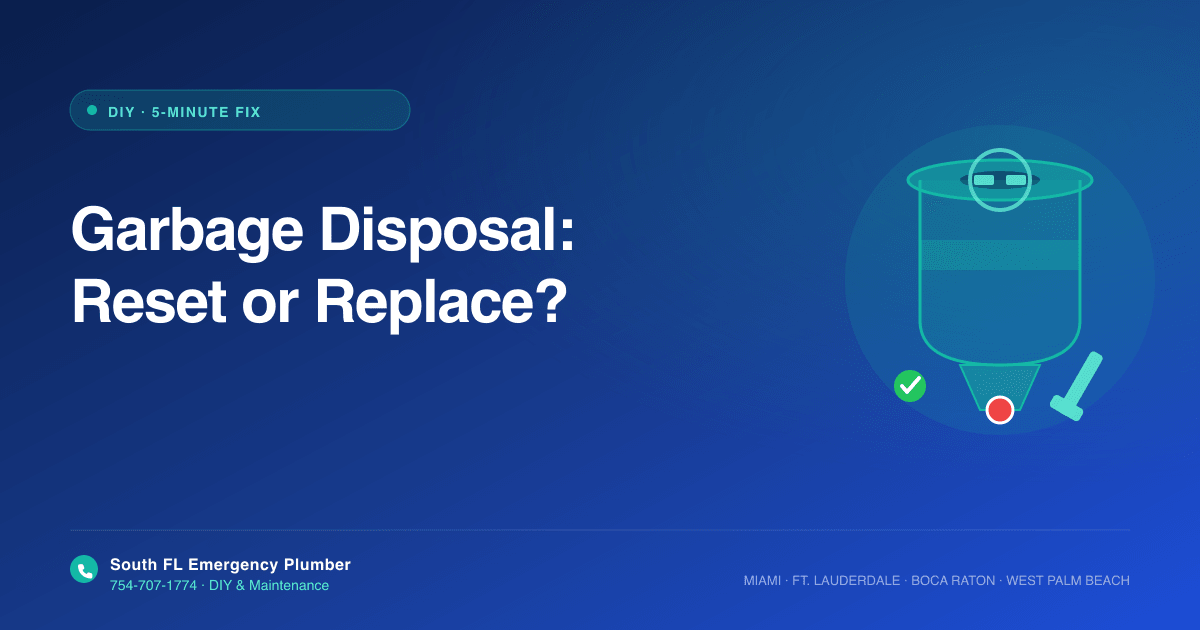
A garbage disposal that won't turn on is one of the most common kitchen calls we get — and honestly, most of them don't need a plumber at all. Four times out of five, the unit isn't broken; it's tripped, jammed, or overheated, and you can bring it back to life in about five minutes with no tools or one cheap one. The trick is knowing which symptom you're looking at, because a small handful of them mean the disposal is genuinely done and any 'repair' is throwing good money after bad. This is the exact decision tree we run through under the sink.
First, what is your disposal actually doing?
The sound (or silence) tells you almost everything. Match your situation to one of these three:
- Dead silent — no hum, no click when you flip the switch. This is almost always electrical: a tripped reset button, a tripped breaker or GFCI, or a bad switch. Good news, usually an easy fix.
- Humming or buzzing but not spinning — power is reaching the motor, but the grinding plate is stuck. This is a jam or an overload. Also fixable, but don't keep flipping the switch — you'll burn out the motor.
- Spinning but grinding poorly, leaking, or stinking no matter what — the mechanical guts or the housing are wearing out. This is the replace category.
Fix #1: The reset button (for a dead-silent unit)
Every disposal has a small red or black reset button on the bottom of the unit. When the motor overloads or overheats, an internal breaker pops this button out to protect itself. Resetting it solves a huge share of 'dead' disposals.
- Make sure the wall switch is OFF.
- Reach under the sink and feel the underside of the disposal for the protruding button. Push it firmly back in until it clicks and stays.
- If it won't stay in, the motor may still be hot — wait 10–15 minutes and try again.
- Still nothing? Check your electrical panel for a tripped breaker, and check whether the outlet under the sink is on a GFCI that needs resetting.
- Turn the wall switch back on and test with cold water running.
Fix #2: Free the jam (for a humming unit)
Humming means the motor is trying but something — a fruit pit, a chicken bone, a bottle cap, an olive seed — is wedging the impeller plate. We see a spike in these every time the snowbirds and summer entertaining seasons hit and kitchens run double-duty. Here's how to clear it without damaging anything:
- Cut the power (wall switch off, breaker off). Do not skip this.
- Look in the bottom of the disposal — most units came with a small hex (Allen) wrench, often clipped to the unit or in a kitchen drawer. There's a hex socket dead-center on the bottom of the disposal.
- Insert the wrench and rock it back and forth, clockwise and counter-clockwise. You'll feel the plate break free and spin.
- No wrench? Insert the handle end of a sturdy wooden spoon down into the disposal from the top and use it to manually rotate the grinding plate. Never use your hand.
- Fish out whatever caused the jam with tongs or pliers — never fingers.
- Restore power, run cold water, and tap the reset button if needed before switching it on.
When to stop resetting and replace the unit
If you've reset and cleared and the unit still misbehaves — or if any of the following are true — you're past the point of repair. On most disposals the motor and housing aren't worth fixing; a new mid-grade unit installed costs less than chasing a failing one. Replace it when you see:
- Water leaking from the body of the unit itself (not just a loose drain or hose connection). A cracked internal shell means water is reaching the motor — that unit is finished.
- You're hitting the reset button constantly. Frequent tripping means the motor is failing.
- It grinds slower and slower on the same food it always handled — dull components or a weakening motor.
- A smell you cannot get rid of no matter how you clean it, often a sign of gunk built up in a chamber you can't reach.
- Persistent rattling or grinding-metal sounds after you've confirmed nothing is stuck.
- The unit is over 10 years old and acting up — at that age, repair parts rarely pay off.
The South Florida angle: hard water and shared drains
Two local realities shorten disposal life here. First, much of the tri-county area runs hard, mineral-heavy water; scale builds up inside the grind chamber and on the impellers, which is part of why local disposals tend to lose grinding power and develop odors faster than the manufacturer's brochure suggests. Plan on roughly 8–12 years, and less on a builder-grade or budget unit. Second, in condos and townhomes on a shared drain stack, a disposal that pushes poorly-ground food and grease into the line doesn't just clog your trap — it can contribute to a backup that affects the units below you. Some associations actually restrict or prohibit disposals for exactly this reason; if you're in a building, check your rules before replacing or adding one.
Keep a healthy disposal healthy
- Run cold water before, during, and 15 seconds after every use.
- Feed it gradually — don't stuff a full bowl of scraps in at once.
- Keep out the killers: fibrous stuff (celery, corn husks, artichoke), grease and oil, coffee grounds, eggshells, rice and pasta, and fruit pits.
- Grind a few ice cubes and a little cold water monthly to knock scale and debris off the impellers.
- Drop in a halved lemon or lime now and then for odor — South Florida citrus is good for something besides the backyard tree.
When to stop DIY and call us
Call a licensed plumber if: the disposal is leaking from its body, the breaker trips every time you run it (an electrical fault, not a disposal jam), you smell anything like sewage from the drain, or you've confirmed it needs replacing and don't want to wrestle the drain, dishwasher hose, and mounting ring yourself. We handle disposal replacement and the drain work around it across Miami-Dade, Broward, and Palm Beach — and if a jam turns out to be a deeper clog in the line, we're already there to clear it. Call 754-707-1774.
Need a Plumber Now?
24/7 service across Miami-Dade, Broward & Palm Beach. Same-day availability.


