
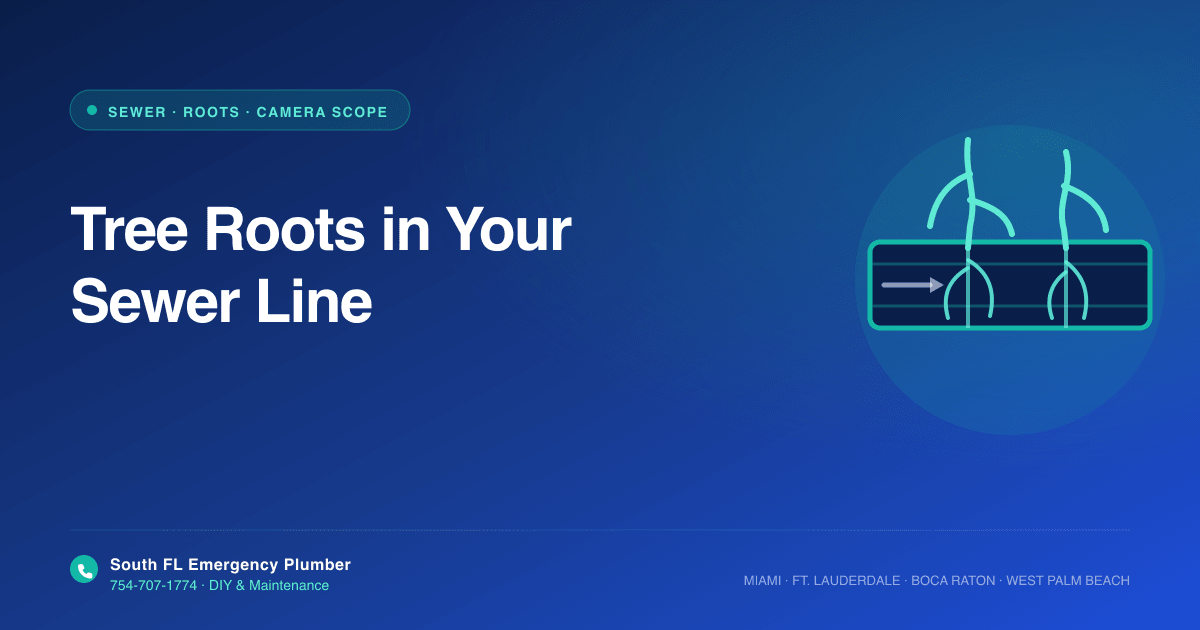
Most homeowners meet this problem twice before anyone names it. The first time, a drain backs up, somebody clears it, and life goes on. The second time — a few months later, same drain — it starts to feel less like bad luck and more like a pattern. That pattern is the diagnosis. Roots grow back at a fairly predictable rate, so root intrusion produces a repeating clog on a rough calendar, while an ordinary blockage that has actually been removed simply stays gone. If you have cleared the same line more than once in a year, this guide is about your house.
Why South Florida is close to a worst case for this
Root intrusion happens everywhere, but a few things stack against us here. There is no dormant season, so roots grow twelve months a year instead of six. Our sandy fill drains fast and offers almost no resistance, so roots travel farther from the trunk than most homeowners expect — the tree does not have to be near the pipe to be in the pipe. And a lot of Miami-Dade and Broward housing stock predates the 1970s, when vitrified clay was standard for sewer laterals. Clay does not rot, but it is laid in short sections, and every joint between sections is a seam that ground movement and time can open. A hairline gap leaking nutrient-rich water into dry sand is, from a root's point of view, the best thing in the yard.
The species matter too. The trees that give us the most trouble across the tri-county area are the ones people love most:
- Ficus and banyan — by a wide margin the most aggressive root systems we encounter in South Florida yards, and the ones most likely to be found inside a lateral.
- Mango and avocado — dense, shallow, moisture-seeking root mats common in older residential lots.
- Royal poinciana and black olive — wide surface root spread that lifts driveways and finds pipe joints on the way.
- Melaleuca and Australian pine — invasive, fast, and still present in and around many older properties.
- Live oak — slower than the others, but a mature specimen has enormous reach.
The signs, in the order they usually appear
- Gurgling. A toilet that burbles when the washing machine drains, or a tub that gurgles when you flush, means air is being pulled through standing water in a partly blocked main. This is often the earliest sign and the most ignored.
- Slow drains in more than one place at once. One slow sink is a sink problem. A slow tub plus a sluggish toilet plus a laundry line that backs up means the restriction is downstream of all of them.
- The clog that comes back. Cleared, fine for a few months, slow again. This rhythm is the single most reliable indicator of roots rather than a one-off blockage.
- Backups at the lowest fixture. Water rising in a first-floor shower pan or a floor drain when another fixture is used is the main line telling you it has nowhere to send the flow.
- Sewage odor outdoors, or indoors near a floor drain. A cracked lateral leaks smell as well as water.
- A strip of lawn that is greener, lusher, or spongier than the rest — and stays that way through dry weeks. That grass is being fertilized by your sewer.
- Soft spots, small depressions, or settling in the yard or driveway above the pipe run, which point to soil washing into a broken line.
What you can do yourself, safely
There is real DIY here, but it is diagnostic and preventive rather than mechanical. Cutting roots out of a buried lateral is not homeowner work — a rented drum machine that catches a root ball can whip, and in fragile clay pipe an inexperienced cable can turn a crack into a collapse. What you can do is narrow the problem and document it so the eventual service call is short:
- Find your cleanout. It is a capped pipe, usually white or black plastic or a brass plug, at ground level near the house on the sewer side, often close to a bathroom wall. Knowing where it is saves time on every future call. If you never find one, note that — a house with no accessible cleanout is worth adding one to.
- Map which fixtures are affected and in what order they slow. Write it down. "Toilet and tub in the back bathroom, plus laundry, but the kitchen is fine" tells a plumber roughly where on the run the restriction sits.
- Log the dates. Every time the line is cleared, note the date. Two clearings a year apart is a maintenance conversation; two clearings four months apart is a broken pipe.
- Walk the run outdoors and photograph anything unusual — a green stripe, a soft patch, settling pavers, a new sinkhole-like dip.
- Stop running water into a line that is backing up, including the dishwasher and washing machine, which dump volume fast and are the usual cause of the flood that follows the warning signs.
What root killers actually do — and don't
Foaming root killers are the one over-the-counter product in this category worth understanding, because they work on a real mechanism. The active ingredient in the common ones is dichlobenil, an herbicide. Because the product foams when it meets water, it expands to contact the top of the pipe as well as the bottom — which matters, since roots enter through joints all the way around, not just where the water flows. It kills the root tissue it touches and discourages regrowth at the pipe wall. Older copper sulfate crystals settle along the invert and treat far less of the pipe, which is why foaming products have largely replaced them.
How the line actually gets cleared
Two mechanical methods, and they are not interchangeable. A sewer machine running a heavy cable with a root-cutting blade bores through the mat and restores flow quickly — it is the right first move when a house is backing up, because it is fast and it works through standing water. What it leaves behind is the fine root hair still anchored to the pipe wall, which is the seed of the next mat. Hydro jetting sends water through a nozzle at high pressure and scours those walls clean, so it buys substantially longer relief. Jetting is not automatically the right call on every pipe, though: on old clay or badly channeled cast iron, pressure has to be matched to the pipe's condition, and that judgment is why the camera comes first.
The camera is the part homeowners are most tempted to skip and the part that decides everything. A scope shows whether you have a single root ball at one joint or intrusion at six joints along the run, whether the pipe is clay, cast iron, or PVC, whether it is cracked, offset, bellied, or holding shape, and how far from the cleanout the trouble sits. That footage is what separates "clean it and set a maintenance interval" from "this pipe is failing and cleaning it again is money you will spend twice." Ask for the video, not just the verdict.
Fixing it so it stops coming back
Cleaning treats the symptom. Roots keep coming back as long as there is an opening, so a pipe with real structural damage needs one of the following:
- Spot repair — excavate and replace the failed section only. Sensible when the camera shows one bad joint and the rest of the run is sound, and when the dig is not under a slab, a driveway, or a mature tree you want to keep.
- CIPP lining (cure-in-place pipe) — a resin-saturated liner is pulled into the existing pipe and cured, forming a continuous jointless pipe inside the old one. Because it seals the joints and cracks, it removes the entry points roots use. Trenchless, so it spares hardscape and landscaping.
- Pipe bursting — a head is pulled through the old pipe, fracturing it outward while drawing new pipe in behind. Also trenchless apart from access pits, and it is the option when the existing line is too far gone or too undersized to line.
- Full replacement — open trench, new lateral. Still the answer when the line has collapsed, the grade is wrong, or the route needs to change.
Preventing it in the first place
- Know where your lateral runs before you plant. It generally goes from the house toward the street or an easement in a fairly straight line; a plumber can mark it during any service call.
- Keep aggressive species — especially ficus and banyan — well away from that run. For a large-canopy tree, distance from the pipe is the only prevention that reliably works.
- Do not treat the toilet as a trash can. Wipes labeled flushable, paper towels, and grease do not cause root intrusion, but they are what turns a small root fringe into a full blockage.
- If your home predates the mid-1970s and has never been scoped, scope it once. Knowing whether you have clay, cast iron, or replaced PVC changes what you should be watching for, and it is useful documentation at sale or at insurance renewal.
- Once roots have been found, set a maintenance interval and keep it. Jetting on your schedule during business hours costs less and is far less disruptive than an emergency backup on a Sunday night.
When to stop and call a plumber
Call the same day if sewage is backing up into a tub, shower, or floor drain, if more than one fixture is backed up at once, if the cleanout is overflowing, or if you smell sewage indoors. Those are not slow-drain situations — they are an active sanitary backup, and the exposure risk is real. Call soon, but not urgently, if you are seeing gurgling, a returning clog, or a green stripe in the lawn: that is the window where this is still a scheduled repair instead of an emergency.
- We camera-scope the line first and give you the footage, so you can see the root intrusion and the pipe condition yourself rather than taking our word for it.
- We cable or jet based on what the pipe can take — old clay gets treated differently from PVC, and we will tell you when jetting is the wrong tool.
- We locate and mark the lateral run so you know where not to plant, and we can add a cleanout where a house does not have an accessible one.
- We handle spot repairs, lining, and replacement, and we will say plainly when a line is sound enough that cleaning plus a maintenance interval is the honest answer.
- Call 754-707-1774 — 24/7 across Miami-Dade, Broward, and Palm Beach. If you have an active sewage backup, say so when you call.
Need a Plumber Now?
24/7 service across Miami-Dade, Broward & Palm Beach. Same-day availability.


